The Subtle Art of Choosing the Right KPIs

As we’ve said before, you get the outcomes you measure for. For example, if you set a goal to get healthier, you might decide that your weight is your KPI: it’s good when the number on the scale goes down. Maybe you can achieve this goal simply by eating less, but you might also be depriving your body of necessary nutrients. Your weight goes down, but you’ll also be getting less healthy in the process.
When you set goals, you need metrics to tell you whether or not you are reaching your goal. But arbitrarily choosing a set of key performance indicators is not enough. You’ve got to pick the right KPIs if you want the right results.
What is a Key Performance Indicator?
A KPI is a kind of metric you use to track progress toward important business goals. Not all metrics are KPIs. KPIs track progress toward the most important goals of your business and must be aligned with your strategy.
Define Your Strategy and Set SMART Goals
Before you can set KPIs, you must first define your strategy: what you sell, how you sell it, your competitive advantage, your differentiators, and the resources you have available. For more on creating your strategic roadmap, see this article or watch a replay of this webinar.
Once you have a strategy mapped out, you need a way to determine whether or not your strategy is yielding the right results. That’s where SMART goals come in. SMART goals are:
- Specific
- Measurable
- Achievable
- Relevant
- Time-Bound
For further explanation of what all this means, see this article.
One more thing: goals are not “set and forget.” It’s important to periodically get the lay of the land. Things change every day in business, and a goal that was relevant yesterday might not be relevant tomorrow. What seemed achievable may suddenly become out of reach, or a sudden surge in sales means a goal you expected to achieve in six months is achievable today. Rules are made to be broken, and goals are made to be re-evaluated. Just don’t re-evaluate so often and arbitrarily that you never make any progress because you’re constantly going back and moving the goalposts.
The Difference Between Metrics and KPIs
Choosing the right KPIs is a complicated process that requires a great deal of insight and analysis. It’s not always obvious which metrics should become KPIs and which are better used to measure your progress toward a KPI. Let’s return to an example we used when discussing the importance of data in strategic planning to illustrate this point.
If you’re creating an email marketing campaign to support your goal of increasing revenue by converting more leads, you might choose “email read rate” as a KPI. As a result, your marketing team focuses on creating emails that get read: attention-grabbing subject lines, preheaders that make you want to read more. Read rates increase to 50%.
While a 50% read rate is definitely good, read rates don't necessarily translate to revenue. More relevant metrics are click rates and meeting rates, as they can be directly correlated with sales. Relevant metrics, yes, but still not KPIs. If your goal is to increase revenue by converting more leads, your KPIs will be conversion rates, sales revenue, and sales growth. Getting your emails read isn’t your final goal; it is a means to an end: increase revenue.
When choosing which metrics to use as KPIs, always keep your strategy and your goals in mind. If you choose the wrong KPIs, you will get the wrong results. For example, your website analytics might provide a “time spent on page” statistic for your ecommerce site. Your data might also show that shoppers who spend more time on the website are more likely to buy. Those can be useful metrics that give context to KPIs. But if you make increasing “time spent on page” from, say, 45 seconds to 1 minute one of your KPIs, your team will focus on that goal at the expense of your strategic goals.
Here’s what can happen if you make “time spent on page” a KPI. You could make each page more engaging, you could write unique product descriptions that shoppers love to read, you could provide more photos and videos of each product. But since “time spent on page” alone is the KPI, your UX/UI team decides to reach their target by making the site harder to navigate. They bury products behind multiple menus, put pricing and sizing information “below the fold” so shoppers have to scroll further to find what they’re looking for, they put lots of extraneous, unrelated material on each page so shoppers have to take more time to unravel the visual clutter, and they add an endless scroll to distract shoppers.
For a while, customers might spend more time on each web page as they try to find what they’re looking for, but they’ll soon grow frustrated and start shopping somewhere with a more user-friendly UI.
A KPI like this might also conflict with your strategy. If your strategy involves differentiating your business through your superior customer service, your goal of keeping customers on pages for longer harms your pursuit of that goal by making shopping more frustrating and more distracting.
There’s No One-Size-Fits-All Answer to KPIs
Every business has its own unique strengths and position in the market. That’s why it's so important to develop a strategy tailored to exactly where you are now and where you want to be. Choosing the right KPIs is a complex part of your strategic roadmap, and getting it right is vital to following through on strategy and reaching your goals
Andrea Hill's
Latest Book
Straight Talk
The No-Nonsense Guide to Strategic AI Adoption
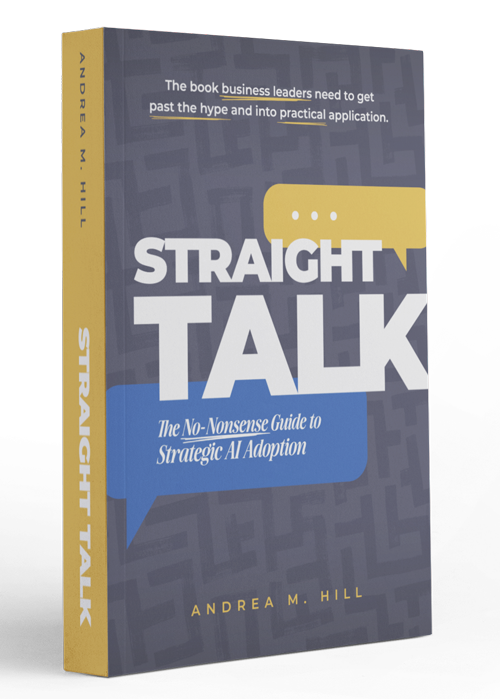
Where other books focus on prompts and tools, this book gives business leaders what they actually need: the frameworks and confidence to lead AI adoption responsibly, without having to become technologists themselves.