The Importance of Data in Strategic Planning

When you’re standing in the pasta sauce aisle, trying to figure out which sauce to buy, how do you make that decision? You have a few options beyond just grabbing one with a nice label. You can compare prices, you can look at ingredients, or you can ask your friends who like to cook which one you should buy (though one of them will surely tell you to buy a can of tomatoes, tomato paste, garlic, onions, herbs, and spices, and make your own). All of that information—price, ingredients, customer reviews—is data. Without data, it’s difficult to make an informed decision.
The same is true whether you’re developing strategy, setting goals, deciding on which KPIs to measure, or brainstorming ideas for new products or marketing campaigns. Collecting and acting on data gets a little more complex when you have thousands of customers to please rather than the two or three family members you’re feeding that night. But because the stakes are so much higher and you don’t have a close personal relationship with all of your customers, knowing how to incorporate data into your strategic planning is that much more important.
Collecting Data
“Data” comprises all of the numbers and statistics collected by your various systems over the course of doing business. It includes number of customers, number of sales in a given period, revenue, website views, email click-through rate, and customer feedback. On its own, data doesn’t do anything. But analyzed well, it can help you make more effective and well-informed business decisions.
In the past, data-driven decision-making was only for the big businesses that could afford it. But data and analytics have become accessible to businesses of all sizes over the last decade or so. From your Google Analytics dashboard to your social media accounts to your CRM, you’re probably collecting more data than you know what to do with. As important as data is, the trick to incorporating it into your strategic planning is understanding how to determine what is and isn’t important, given your goals.
Evaluating and Using Data
Data alone does not tell you what to do, and focusing on one data point without recognizing how multiple data points relate to each other can lead to poor decisions. For example, you might notice that your emails are being opened 50% of the time and determine that email is your strongest outreach channel, so you build a strategy around email campaigns.
This is a data-driven decision, but it is one based on a misinterpretation of the data. High read rates are good; they tell you that your subject lines and email copy are resonating with your audience. But a high read rate alone does not translate to revenue. It is the click-through rate that more accurately correlates with sales. While that high read rate suggests that your copy is getting attention, a low click-through rate might suggest that you are targeting the wrong leads, or that the email copy is not aligned with the message of the subject line. To use data effectively, you have to know what different data points actually mean for your business and how they interact to give you a full picture of your business.
Data Can Improve Decision-Making
Every business decision comes with some amount of uncertainty and risk. Developing a strategy around clear, achievable goals helps mitigate risk and build resilience against uncertainty. Data is what helps you set the right goals and measure the right things.
In the times before data was readily available to small businesses, strategic planning relied on received wisdom and the lessons of the past, lessons that might not apply to today’s market or your particular situation. Your own data, whether collected from your own customers through your own platforms or through competitive analysis, speaks directly to the present moment your business faces. Furthermore, what you find might contradict what everybody else assumed was true, opening up a path that no one else is taking.
Data can also reveal that decisions that seemed common sense are actually counterproductive to your goals. For example, if you’re reading everywhere that every business needs to adopt a new technology or methodology, and business leaders are parroting what they read, and media influencers are parroting those business leaders, you may fear being left behind and hastily hop on board the latest trend. A data-driven approach, however, might reveal that the gains from these technologies or methods are small or nonexistent, or only beneficial when implemented in a certain way. This is a case where data can save you from making a costly strategic error.
Strategic Planning Requires Data
Whenever it’s time to make a decision, it’s tempting to rely on intuition and assumption. Your intuition and the knowledge you’ve gained over the years is important. Data can support or challenge your assumptions. It can supplement your existing knowledge or teach you new things. Even when you involve data in the decision-making process, you still have to know how to interpret the interplay of multiple points of data. We’re here to help you find the data collection tools that are best for your business and help you use that data to develop a strategy that will keep you strong through turbulent times.
Andrea Hill's
Latest Book
Straight Talk
The No-Nonsense Guide to Strategic AI Adoption
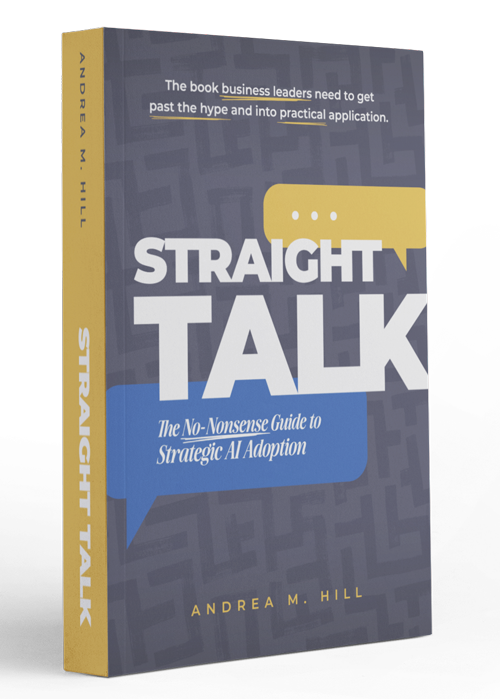
Where other books focus on prompts and tools, this book gives business leaders what they actually need: the frameworks and confidence to lead AI adoption responsibly, without having to become technologists themselves.