Understanding the Regulatory Landscape in Your Industry
When we talk about resilience, it’s often in the context of surviving globe-spanning disasters beyond our control or understanding: pandemics, war, climate change, recessions, market crashes. But building a resilient business means being ready for any kind of change, even changes in the regulations that govern your industry.
In the absence of strong, clear policies at the federal level, we’re seeing individual states creating a patchwork of laws and regulations of their own. As a result, the federal government, state governments, businesses, and citizens are locked in constant legal battle, and confusion reigns. We see this happening all over the country, from the environment to labor law to AI regulation.
The word “landscape” conjures images of idyllic pastures, reflective ponds, lush foliage, and rolling hills rendered in dreamy watercolor, but today’s regulatory landscape is more a dreary, heavy oil painting of rivers of lava dribbling into a turbulent ocean: a gloomy, frightening, confusing place where the ground is constantly shifting beneath your feet. Staying in compliance isn’t as difficult as it looks, though, and it grants benefits beyond remaining on the right side of the law. Compliance mitigates risk, builds consumer trust, and can give you a competitive advantage.
Understanding the Regulatory Landscape Helps Mitigate Risk
Depending on your industry, you’ll have to navigate a patchwork of regulations administered by an alphabet soup of government agencies: EPA, FDA, FTC, OSHA, etc. Failing to comply with applicable regulations could result in fines as well as reputational harm. This website tracks fines handed out for noncompliance with the EU’s General Data Protection Regulation (GDPR), while this one will show you some of the largest fines handed out by US agencies.
Risks don’t only take the form of noncompliance. There is always the risk that regulations will tighten in the future. If you don’t have a regulatory risk strategy, you could find yourself facing expensive physical or digital infrastructure upgrades or training programs. If you’re following public policy debates and understand how different administrations might seek to govern, you can prepare yourself for changes before they happen.
Enhance Reputation and Gain Consumer Trust
Failing to comply with regulations, particularly regulations around product safety, labor rights, or environmental protection, can cost you customers and hurt your ability to attract top employees. Once the public has a certain image of a business, that image can be hard to shake. Consumers have so many options for most products and services that it’s almost a relief to be able to eliminate an option because they heard a business was a polluter or treated their employees poorly. The government might not enforce their regulations, but the public will.
Follow the Most Conservative Rule
In the absence of federal policy, or in the cases in which federal regulations are weaker than state regulations, follow the most conservative state regulation. If you’re doing business globally, follow EU regulations, which tend to be stricter than American ones, particularly in regards to privacy and security in the digital realm. It might seem like you’re unnecessarily burdening yourself, but in reality, you’re making yourself more resilient and already prepared if stricter regulations are enacted in the future. Policies that protect user privacy are popular with consumers, which can give you a competitive advantage in markets where regulations on data collection are looser.
Develop Compliance Processes
Don’t be caught off guard by regulatory changes. Learn which regulatory agencies are relevant to your industry. Assign the responsibility of tracking regulatory changes to a staff member and make compliance a cultural value. That means building processes with compliance in mind. In general, things get done the right way when the right way is easier or more intuitive than the wrong way. That’s why it’s so important to onboard, train, and reinforce training through clearly mapped processes. These processes should include ways to document and report compliance so that your business is prepared in case of an audit.
Compliance Is About More Than the Law
It’s one thing to follow the letter of the law as it stands today. That’s the bare minimum expected of any business. When you go further than the law requires, you’re future-proofing your business, and you’re enhancing your reputation in the eyes of consumers and prospective employees and giving yourself a clear competitive advantage.
Andrea Hill's
Latest Book
Straight Talk
The No-Nonsense Guide to Strategic AI Adoption
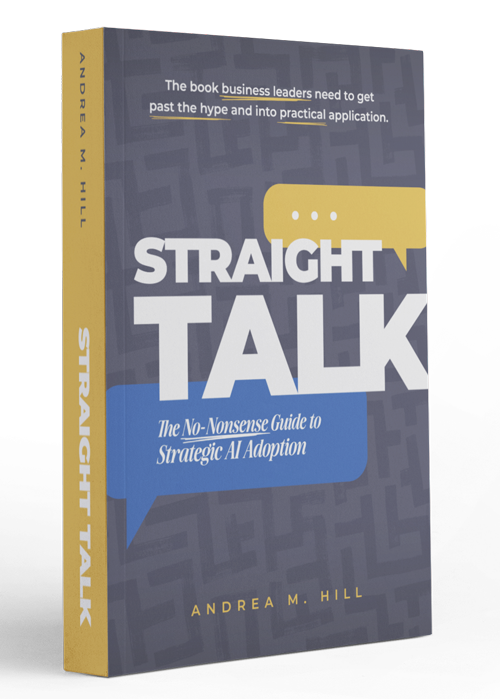
Where other books focus on prompts and tools, this book gives business leaders what they actually need: the frameworks and confidence to lead AI adoption responsibly, without having to become technologists themselves.