Pricing Strategies for Growth and Profitability

Pricing is one of the more arcane and confusing aspects of running a business. Even seasoned business owners struggle with finding the right price point for their products. There are a number of reasons for this. Some are afraid of price increases and will price their inventory too low. Others struggle with the work of costing materials and labor. Another group is so focused on competitive pricing that they fail to consider the value their brand and their products bring to consumers.
You can easily find yourself frozen in the face of these problems. After all, if you don’t get pricing right, you’re not bringing in revenue, either because you’ve priced your products so low that you can’t make a profit or so high that no one is willing to pay for them. This article will help take some of the stress out of pricing.
Track Costs
Knowing how much you’re spending on each product is fundamental to your pricing strategy. Create a “recipe” for each product detailing the cost of each individual material component and how much labor goes into each part. But as important as it is to know and control your costs, prices should not be locked to costs. If you let costs drive prices, you will never grow. Pricing should be a little more free-floating, signaling not just what a product costs to make but what value it is providing to customers.
Whether you are making your own components or buying from a supplier will also influence your pricing. If you are a retailer buying from a supplier, or a B2B business purchasing components from manufacturers or vendors further up the supply chain, make costs easier to track and control by buying from as few vendors as possible.
If you’re making many small purchases from fifty different vendors, or you are changing vendors frequently, you never get to build a relationship with any of them. Since each one only does a small amount of business with you, you can’t go to each one and negotiate better prices from the standpoint of someone who makes several large-volume purchases on a regular basis. Fewer vendors means greater purchasing power for you. What would you rather have: fifty friends you talk to once a year, or three really good friends who would change your flat tire or help you move a piano at a moment’s notice, no questions asked?
Finally, are you factoring in your own labor when calculating costs? Small business owners either undervalue or overvalue their own labor, or they forget to factor it in at all. Break down all of the different roles you play and think about what each of those roles is worth. Include that labor where appropriate in your cost analysis.
Cost-plus pricing, in which you aim to recover the cost of production and make a profit on top of that, is the most common pricing strategy. The “cost” part of the equation is easy enough to calculate, but what goes into determining the “plus”?
Standard Markup
The first factor is the markup. Each industry has its own markup standards. How much you decide to deviate from that depends on a number of factors. First, there’s how you want your product to be perceived. Is your brand “cheap and accessible products for the masses” or is it “luxurious and exclusive, only for a discerning clientele”? Is it an “entry level” or “starter” product or does it have all of the features an experienced user would need? In addition to considering the standard markup for your industry, consider what message your pricing sends to consumers.
Competitor Pricing
Whether or not you should monitor competitor pricing depends on your industry and the messages about your products’ value you want to send. How your competitors price similar products can give you a baseline to work from, but too rigorously tying your process to the competition is a race to the bottom. If you’re chasing after price-conscious customers, there’s always someone who can charge less than you.
Rather than chase price parity, show the value of your own products. This means establishing a brand that resonates with a particular group of customers who want what only your brand can provide. You want customers who will say, “It costs more, but it’s worth it,” whether because of superior quality or superior service or because your values align with theirs.
Inventory Control
As you continue to refine your offering and pricing strategy, make use of the data available to you in sales reports. What is not meeting minimum quantities? What is not worth ordering inventory on? What are your best sellers? Where and when are different products selling? If a product isn’t selling well enough to justify the cost of materials and labor, you might want to discontinue it. On the other hand, if customers who buy that product tend to buy it with a product with a much higher margin, you might want to consider keeping it.
Cutting Prices and Selling Below Cost
Businesses that aren’t selling often think they need to lower their prices. In most cases, the problem isn’t the price. It’s that you’re not doing enough marketing, not doing enough selling, or not sufficiently demonstrating your brand value.
Selling below cost is also not always a great strategy for bringing in new customers. A loss leader might provide a temporary increase in sales or get a wider audience interested in your products, but those price-conscious customers won’t stick around when prices go back up. Rather than sales volume, the metric to track for growth is customer lifetime value. Lowering prices might result in a temporary revenue boost, but finding the right customers who will buy from you again and again over the course of their lives will ensure long-term growth and resilience.
A Customer-Centric Pricing Strategy
Component and labor costs and competitive analysis have their parts to play in your pricing strategy. Data analysis can help you control inventory and cull your worst-performing products. But the most important factor in your pricing strategy is the customer. It’s important to remember that pricing strategy is also marketing strategy. How your pricing reflects your brand is one of the most important things to consider. It’s so important, in fact, that we wrote a whole article on it over on Werx.Marketing, which you can read here. As you develop your pricing strategy, make sure to take a look at this article for a fuller picture of how pricing and marketing are intertwined.
Andrea Hill's
Latest Book
Straight Talk
The No-Nonsense Guide to Strategic AI Adoption
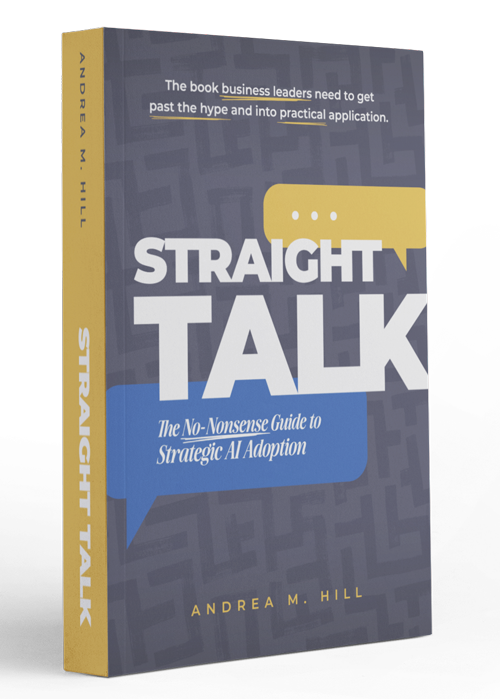
Where other books focus on prompts and tools, this book gives business leaders what they actually need: the frameworks and confidence to lead AI adoption responsibly, without having to become technologists themselves.