Understanding Customer Lifetime Value
In most endeavors, it’s hard to know if you’re doing well or in need of improvement if you don’t have something to measure your performance against. We all know we need to set goals, and we need metrics against which to track our progress toward those goals. The difficulty lies in deciding what to measure.
If I set a goal to get healthier, for example, how do I know I’m achieving my goal? I could say that weight is a KPI: more is bad, less is good. But making “less weight” my goal can lead me toward some counterproductive behaviors like restricting food intake to the point I’m starving myself of nutrients. I’ll end up weighing less, but I’ll also be suffering from malnutrition. So should I measure BMI instead? Well, if my muscles start to atrophy from lack of exercise, I’ll lose dense muscle mass and gain fat, and my BMI will go down while my body gets weaker. While the number on the scale is a metric by which you can track your overall health, focusing on that number alone isn’t the best way to get healthier. Whether you’re making changes in your personal life or running a business, you get the results you measure for.
That’s why customer lifetime value is such a valuable growth metric. When you track this metric, you’re going beyond measuring success by how many customers you have or how much you sold today, this month, or this year. Measuring customer lifetime value forces you to think about sales as a lifelong relationship. Instead of chasing as many customers as possible, the goal becomes finding the right customers, the ones you can establish a long and fulfilling relationship with.
Customer Lifetime Value Defined
Customer lifetime value is the total revenue you expect a customer to generate over the course of your relationship. The concept originated with balanced scorecard, a business strategy framework that balances the perspectives of a number of stakeholders, from investors to employees to customers, in measuring and evaluating performance. Balanced scorecard is one of the most widely used business frameworks, but you don’t have to run your business according to its principles to get value from measuring customer lifetime value.
Calculating Customer Lifetime Value
Determining how much a customer is worth to you isn’t as complicated as it sounds. The answer comes from three things: how often they buy, how much they spend each time, and how long they tend to stay engaged with you. The answers to these questions vary by industry.
For example, customers for infant and toddler apparel make many purchases, but only over a short period of time: from a few months to a few years. In the jewelry industry, customers will make fewer purchases but those purchases could extend over a lifetime: an engagement ring, wedding bands, anniversary gifts, graduation gifts for their children, a retirement watch.
Not every single customer is going to stay with you for that long, so your churn rate should be factored into your calculation. The formula looks like this:

This calculation doesn’t have to be perfect, just a ballpark figure that can help you make strategic decisions.
Why Track Customer Lifetime Value?
In some businesses, you can expect a customer to buy from you once and never again: a real estate agent, for example, probably doesn’t expect to sell multiple houses to the same customer. But in most other businesses, especially in B2B, lasting relationships are the key to growth. Advertising and marketing to acquire new customers can be expensive, while nurturing a relationship with an existing customer is more cost-effective. B2B organizations also have to consider that there are often a limited number of leads and greater competition, making a focus on customer lifetime value even more important.
Measuring customer lifetime value helps you identify the customers you don’t want as well as the customers you want. While it’s true in general that acquiring new customers is more expensive than retaining old ones, you can probably think of a few customers of your own who are costing you more money than they create in revenue. Measuring customer lifetime value elevates customer service and building relationships over making a lot of one-time sales, but it also lets you separate your profitable customers from the ones you might be better off severing your relationship with.
Finding the Right Customers for Long-Term Growth
You get the results you measure for, and measuring customer lifetime value will lead to a greater focus on finding the right customers and keeping them satisfied. When you prioritize customer lifetime value, you see customers not as a transaction but as a relationship that rewards both parties. It’s an important piece of the growth puzzle that will keep you focused on long-term value, not short-term gain.
Andrea Hill's
Latest Book
Straight Talk
The No-Nonsense Guide to Strategic AI Adoption
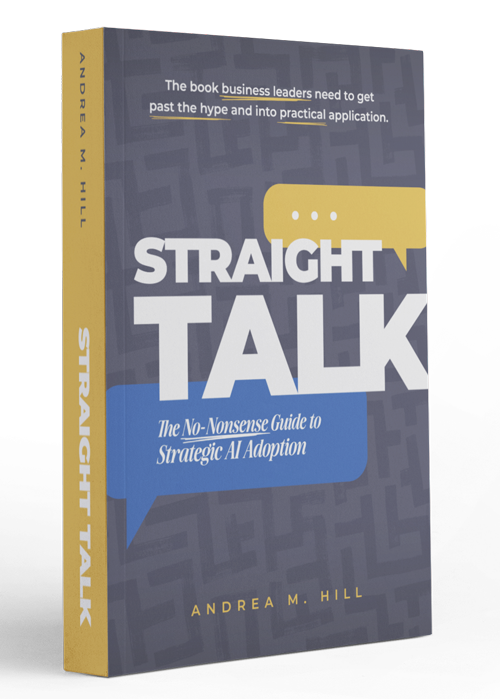
Where other books focus on prompts and tools, this book gives business leaders what they actually need: the frameworks and confidence to lead AI adoption responsibly, without having to become technologists themselves.