The Link Between Employee Engagement and Business Performance

An engaging work culture is often seen as something that sits on top of your business operations, like a garnish that makes a dish visually appealing but has no bearing on the flavor. In reality, culture is an essential ingredient to success. It’s not enough to ask employees to act and work in a certain way; culture arises out of the structure of your business: your hiring, training, and onboarding as well as your processes and policies. Culture has to be aligned with your strategic goals. It’s not just about making people happy but about finding a culture that helps you achieve your goals by helping employees become more engaged in their work and in the business itself.
It’s tempting to write off the importance of employee engagement altogether. If people are showing up and getting their work done, why should we care if they are particularly engaged? Do they really need to enjoy what they do? The fact is, companies whose employees that are engaged in their work bring in more revenue and are more resilient and innovative than companies that show less engagement.
What is Engagement?
The US Office of Personnel Management defines engagement as “an employee’s sense of purpose that is evident in their display of dedication, persistence and effort in their work or overall attachment to their organization and its mission.” Engaged employees derive more personal satisfaction and pride from their work and are therefore motivated to give their best effort.
More Resilience
While we may not be in a recession as of early 2026, the high inflation, low consumer spending, and overvalued stock market we’re seeing right now makes this economy feel awfully recession-ish. One way to recession-proof your business is by creating a culture that fosters engagement. A 2020 Gallup poll found that businesses with engaged workforces recovered more quickly from the 2008 recession. As the US economy weathers all sorts of storms, an engaged staff is what will help you not only survive whatever is to come, but thrive while your competitors flail.
Greater Innovation
Engaged employees care about the future of the business. As a result, they develop more innovative ideas that propel a business into the future. Disengaged employees only think as far as 5 o’clock. They deal with what’s in front of them and then clock out. Engaged employees, meanwhile, think about the future of the business. They are concerned with improving the business. They think beyond the bounds of whatever task they’re working on, connecting the dots between their work and the work of others and proposing solutions to problems. This kind of creative, lateral thinking focused on synthesizing disparate threads into something new naturally leads to more innovative ideas.
Lower Turnover
A 2021 Gallup poll found that engaged employees are less likely to look for another job or leave if they are offered one. If you’ve invested in your talent and helped them develop their skills, you might worry that they will take those skills elsewhere, leaving you train a new hire from scratch. If they are in the kind of work environment that engages them, they will be less likely to start wondering if the grass isn’t greener at that other company.
There are some caveats to make with a survey from 2021. The economy was different then. It was the time of the “Great Resignation,” where a much more pro-worker job market made it easy for workers to hop from one job to the next if they didn’t love their job. Today, workers are more likely to cling to a job they hate because they have no other options.
In this market, engagement is still important. In the past, a disengaged worker would simply leave, giving you the chance to hire someone more enthusiastic about their role. Today, that same worker is showing up and going through the motions, doing just enough to not get fired. Creating an environment that engages this worker saves you the trouble of rooting out the source of bottlenecks and errors caused by disengaged employees. It also saves you the resources you’d have to put into letting an employee go and hiring, onboarding, and training a new one.
Less Burnout
Nothing kills productivity like the sustained high levels of stress and anxiety that lead to burnout. We’re living in stressful times. We’re all lonely and anxious, trying to drown our anxiety and loneliness by scrolling on our phones all night long, which only makes things worse. In the absence of other strong social bonds like family, friendship, and community, it’s all the more important for employees to find contentment and belonging at work, where they spend most of their waking hours. For many, the workplace is a refuge from the stress of the outside world. Making yours into a place where everyone feels welcome and supported will create tighter bonds between employees, leading to higher engagement and all of the benefits that come with it.
Engagement Benefits All
All of the above factors play a role in engagement’s most important benefit: higher revenue. When employees feel a sense of achievement, the business achieves its goals and can set more ambitious goals for the future. That’s why engagement is a key ingredient to business success. As you develop strategy, set goals, and build processes, keep in mind the actual experience of working toward these goals through these processes and look for ways to make work more rewarding and engaging to build a more resilient, innovative, and profitable business.
Andrea Hill's
Latest Book
Straight Talk
The No-Nonsense Guide to Strategic AI Adoption
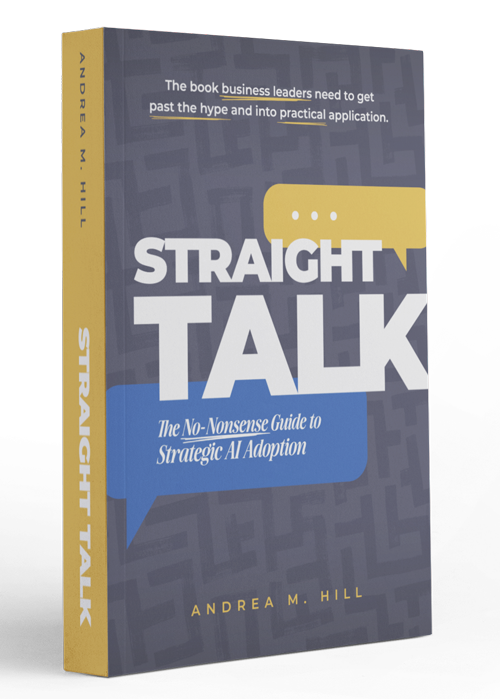
Where other books focus on prompts and tools, this book gives business leaders what they actually need: the frameworks and confidence to lead AI adoption responsibly, without having to become technologists themselves.