Metrics to Track to Achieve Operational Excellence

Of all the departments that make up a business, operations is perhaps the least glamorous. Sales has its charismatic competitors, marketing its creative connoisseurs. Operations, meanwhile, is all about hard work and getting things done. It’s about optimizing processes and improving efficiency. While operations isn’t the life of the party, there is no party without efficient operations in charge of the drinks and the playlist. If you want a business built on a philosophy of continuous improvement that supports delivery, reduces friction, and enables growth, you need efficient operations.
In a business context, the word “efficiency” is often paired with “ruthless,” suggesting that improving efficiency is cold, impersonal, and unavoidably ominous as the swing of the Grim Reaper’s scythe. But making your business operations more efficient isn’t about pinching pennies, cutting costs, or squeezing more out of your employees. Efficiency doesn’t follow from ruthlessness but from wisdom. That wisdom is informed by data.
What Is Operations?
Operations encompasses all of the decisions you make about inventory management, production processes, product development, customer service, and staffing. In short, “operations” constitutes the background processes that keep your business functioning. Even if you don’t have a separate operations department, you have employees engaged in some of these functions, which are essential to the profitability of your business.
How Tracking Metrics Improves Operations
To keep a business running smoothly, operations employees have to constantly diagnose the state of the business. In order for your business to run smoothly and achieve its goals, you need to know which products are selling, whether or not you’re carrying enough (or too much) inventory, how much everything costs, and where your bottlenecks are. When mistakes are made or projects fail, you need to know how, why, and how to avoid the same kind of failure in the future. This work is never finished.
The Metrics to Track
To answer the above questions, you need data. Not just any data, but data relevant to your goals. Metrics are what tell you whether or not you are on track to achieve your goals. They show you where you are succeeding and failing, and how to stay on—or get on—the right track. The following eleven metrics can help you achieve your goals through operational excellence, eliminating waste and optimizing processes.
Stock turnover rate can help identify inefficiencies and waste in inventory.
Overtime hours often indicate staffing issues. If your employees are regularly working overtime, it might be time to hire more staff. Frequent overtime hours can lead to burnout and mistakes, lowering your operational efficiency.
Employee turnover metrics can help you root out ineffective processes or management philosophies that are causing employees to leave.
Overall equipment effectiveness measures if, when, and for how long a particular piece of equipment was available for use as well as how much product it can output in a given timeframe. This metrics tracks breakdowns and maintenance times so you can optimize equipment uptime.
Capacity utilization measures how effectively you are using your resources, including both equipment and labor. Read this number in conversation with overall equipment effectiveness.
Error rate measures mistakes in areas such as the production process, customer service, and order processing. Errors lead to waste as well and loss of trust with customers.
Average order value/average deal size can help you make decisions about inventory and pricing strategy.
Time to complete task can help you understand error rate. Doing things as quickly as possible increases efficiency, but the operative phrase there is “as possible.” Going too fast increases error rate. If employees aren’t given enough time to complete a task, quality decreases and injury risk increases.
Revenue per employee is an overlooked but still important metric. Payroll is often seen as a cost to be cut wherever possible. In reality, employees are your greatest asset. Employees are the ones generating revenue for a company. If revenue per employee is too low, or if it has decreased over time, it might be time to survey employees about their job satisfaction, as low employee engagement may be an issue. Alternatively, low revenue per employee may point to underutilization.
Analyze Metrics in Context
Taken in isolation, some of these metrics won’t tell you much of anything. “Time to complete task” will be very high indeed if your customer service reps are immediately hanging up on every customer who calls with a problem. Outliers or strange results will point you in the direction of an issue, but on their own don’t often have much to say.
For the same reason, metrics shouldn’t be mistaken for goals. If you make “stock turnover rate” a goal rather than a metric that helps you measure progress toward a goal, your inventory managers will simply order less inventory than you need to increase those turnover numbers. Sure, you’ll destroy customer retention and satisfaction when everything they want is out of stock, but inventory managers can say they accomplished their goal!
Rather than serving as ends in themselves, the power of this data lies in its ability to turn raw information into actionable insights. These insights give you a deeper understanding of where your operations processes are working well or need adjustments.
A Culture of Continuous Improvement
The goal is to take small steps toward continuous improvement. When you’re making changes in your life, taking small but consistent steps is far more effective than committing to a huge project, getting overwhelmed, and abandoning it after a week. The same goes for improving operational excellence. If you know which metrics to track, you can continuously make those incremental adjustments that make continuous improvement a cultural value and keep you moving in the direction of operational excellence.
Andrea Hill's
Latest Book
Straight Talk
The No-Nonsense Guide to Strategic AI Adoption
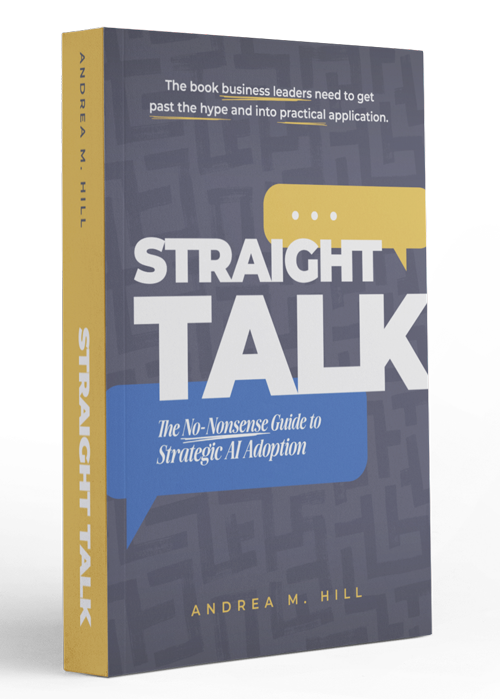
Where other books focus on prompts and tools, this book gives business leaders what they actually need: the frameworks and confidence to lead AI adoption responsibly, without having to become technologists themselves.