Maintain Your Competitive Advantage With an Innovation Strategy

It’s common to think of innovation as something that occurs at the founding of a business and launches it to its initial success: a newcomer with fresh ideas puts a new spin on an old product or fills an unmet need in the market, and now everyone is scrambling to catch up. But innovation is important to mature businesses, too. It’s how they continue to thrive even as the world changes all around them. You’ll have to innovate to stay ahead of your competitors and newcomers alike while keeping up with new customer needs as they arise.
Innovation doesn’t happen on its own. If you just let it come in random flashes of brilliance or moments of inspiration, you won’t be able to count on it when you need it. A drive to innovate has to be ingrained in your culture. Creativity has to be encouraged and rewarded at every turn. Most importantly, innovation has to be approached strategically. When you tie innovation to strategy, you’ll always be coming up with new ideas, and you’ll have a plan ready to act on the best ones when the time is right.
What Is an Innovation Strategy?
There are tactics that get employees to think or act creatively, like brainstorming sessions or suggestion boxes, but creativity exercises aren’t inherently strategic. When you approach innovation strategically, you bake innovation into everything you do. In order to do that, you first have to understand what your business’s purpose is, who your customers are, and where you want your business to go in the future.
That understanding of why, how, and for whom you want to innovate will guide how you approach innovation with your customers in mind. Your innovation strategy will detail the ultimate goals of your innovation efforts and give each department an innovation roadmap. Your innovation strategy will also outline the metrics detailing what success looks like. Goals guide employees in enacting strategy, and metrics are how they know they’re on the right track.
Strategy Defines Culture
Innovation requires more than inspiration. It’s about thoughtfully developing better ways to serve the customer. An innovation strategy extends a culture of innovation to every department of your business. When that culture takes root, innovation becomes more than dreaming up new products. Every department will have goals related to innovation. An operations team, for example, will have goals related to innovating inventory management and making the supply chain more efficient and cost-effective, because those are goals that improve the customer experience. Improving customer service, implementing new sales methods, and testing new marketing strategies are all areas in which innovation can transform a business.
Measuring Innovation
Innovation strategy puts the customer at the center of your innovation efforts and focuses those efforts on innovations that align with business strategy and goals. Progress toward goals must be measured. Metrics set expectations for teams, so it’s important to measure the right things. If this seems a little vague, it’s because choosing the right innovation metrics can be tricky, and the specific metrics you choose will be unique to your industry, strategy, and goals.
For an idea of what innovation metrics might look like, think in terms of time to market, the rate at which customer problems are solved, and percentage of new ideas derived from customer feedback. Speed-related metrics, however, must be used in conjunction with other metrics. You can resolve customer complaints quickly by giving every customer everything they want, or by ending every call after thirty seconds whether you’ve resolved their problem or not. Ultimately, you get the results you measure for, so let our strategy experts work with you to not only define the metrics and KPIs that align with your goals but learn how to interpret the numbers.
Strategy Keeps You Focused on What Matters
You can’t follow every whim. You have to choose your spots. The difference between successful innovators and unsuccessful ones isn’t the number of ideas generated, but the ability to discern good ideas from bad ones, making plans, and following through on them. Failed innovations have their place, too, as learning occurs through trial-and-error, through taking risks that might not pan out, but chasing ideas in haphazard ways is ultimately wasteful. When you tie innovation to strategy, you’ll choose projects more wisely and have the metrics in place to understand what’s working and what’s not.
Andrea Hill's
Latest Book
Straight Talk
The No-Nonsense Guide to Strategic AI Adoption
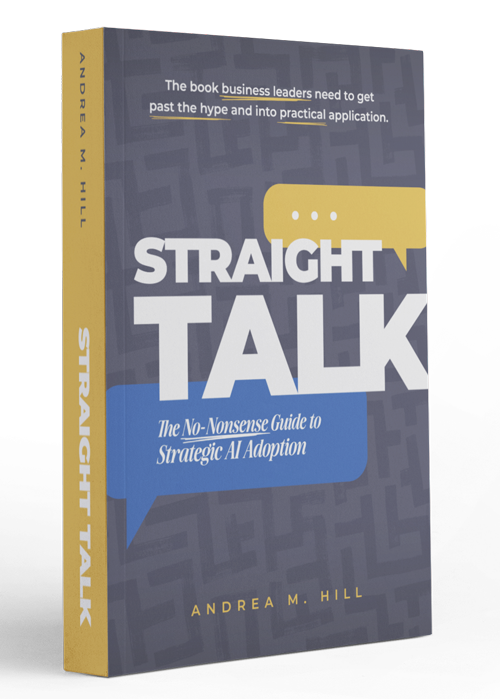
Where other books focus on prompts and tools, this book gives business leaders what they actually need: the frameworks and confidence to lead AI adoption responsibly, without having to become technologists themselves.